Northern Lights Company
The Woman in Cabin 10Northern Lights Company is the corporate enterprise represented by the Aurora Borealis and its owner, Richard Bullmer. The company’s maiden voyage markets Scandinavian luxury as an experience of hospitality, scenery, exclusivity, and controlled reassurance; when a woman disappears and Laura Blacklock reports a suspected murder, that polished identity becomes a liability the organization tries to protect. Its importance lies in the conflict between the company’s promise of seamless luxury and the institutional pressure to suppress anything that might damage the voyage, the vessel, or the livelihoods attached to it.
Corporate Identity and Public Promise
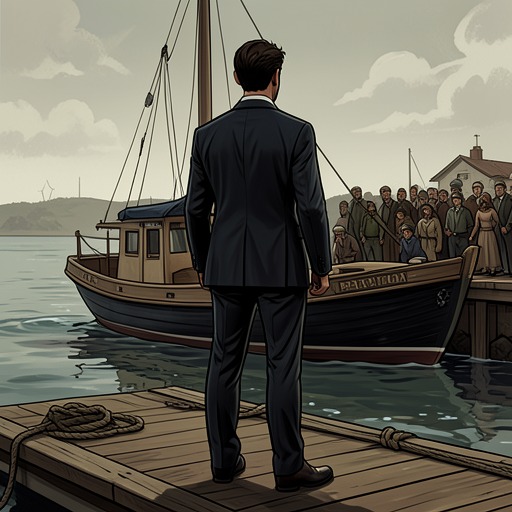
Northern Lights Company is introduced indirectly through Richard Bullmer, described as the owner of the boat and the company’s figurehead. His position makes him both the public face of the enterprise and the person most visibly associated with its success. At the launch reception, he presents the Aurora Borealis as an environment in which travel should not require compromise: passengers are promised attentive staff, comfort, and the fulfillment of their wishes. The company’s rhetoric is therefore not limited to transport. It sells an entire social world, one in which inconvenience, uncertainty, and ordinary financial limits are meant to disappear. The voyage’s branding draws heavily on Scandinavian imagery. Richard invokes Finland’s forests, the Swedish archipelago, the Norwegian fjords, and the northern lights, turning regional landscape into a premium cultural product. The ship’s name joins the company’s commercial identity to the aurora borealis, which Richard calls a defining glory of the Scandinavian winter experience and hopes to share with the passengers. The launch toast treats the maiden voyage as a collective corporate ceremony: passengers raise their glasses to the Aurora Borealis and to the hope that the beauty represented by its namesake will endure.
Structure, Staff, and Class Division
The company’s visible service structure is headed aboard the vessel by Camilla Lidman, who introduces herself as being in charge of hospitality. Her office is on the lower deck, and she presents herself as the point of contact for anything that might make passengers’ stay more enjoyable. Josef is assigned to guide passengers to their cabins and show them the facilities, while the broader crew is described as a small, tightly knit staff. The organization thus depends on personal service and carefully distributed responsibilities, with hospitality functioning as the public interface between the company and its wealthy guests. That service ideal rests on a sharp physical hierarchy. The passenger areas are light and airy, while the crew cabins are cramped, windowless, and dingy. Johann Nilsson explains that only about a dozen staff members, apart from the sailing crew, work on the boat, so little space is considered necessary; he also insists that their quarters are better than those on some rival ships. The comparison does not erase the inequality. For Laura, the ship becomes a visible modern upstairs-downstairs system, with luxury above and constrained labor below. The company’s promise of effortless comfort is sustained by workers whose own environment reveals the material cost of that comfort. The same hierarchy appears in the scale of the passenger experience. Laura estimates that a week aboard the Aurora would cost around eight thousand pounds, an amount she regards as obscene beside her salary and even Rowan’s. Her wonder at finally receiving a taste of a life normally encountered only through travel journalism is accompanied by recognition that ordinary people cannot afford it. Northern Lights Company therefore operates through a contradiction: it offers a temporary fantasy of universal ease to a select class while making the economic distance between passengers and staff impossible to ignore.
Crisis Management and Reputation
The company’s vulnerability becomes clear when Laura reports that a woman may have been thrown overboard. Johann Nilsson, responsible for security, tells her that there is no proof and urges her to sleep before attempting to resolve the matter in the morning. He proposes introducing her to the ship’s staff so that they can search for the woman she saw in the cabin, while noting that no staff member is known to be missing. The response places the burden of verification inside the company’s own hierarchy rather than immediately treating the report as an emergency requiring outside intervention. Laura understands why Nilsson is reluctant to accept an unexplained death during the Aurora Borealis’s maiden voyage, which is crowded with journalists, photographers, and influential guests. A disaster at that moment could threaten his job, but the danger extends beyond one employee. Publicity about a death could sink the whole enterprise before it was fully launched, potentially costing everyone aboard their employment, from the captain to Iwona, the cleaner. The organization’s crisis logic is therefore shaped by reputation risk: preserving the company may appear to require delaying alarm, controlling interpretation, and keeping the incident within the vessel’s internal chain of command. The company also benefits from the uncertain legal position of crimes at sea. Ben Howard observes that crime on cruise ships occupies a murky area, and Laura recognizes the broader problem of criminal acts committed in international waters. Without a clearly established police jurisdiction taking control, investigations can be left to onboard security services employed by the cruise company. Those services have institutional reasons not to ruffle feathers, even when they might wish to investigate. Northern Lights Company is consequently not merely a setting for the mystery; its corporate structure helps explain why evidence can be discounted and why a disappearance can be treated as a reputational problem before it is treated as a criminal one.
Financial and Operational Stakes
Northern Lights Company’s commercial future is tied to the success of the maiden voyage. The cancellation of Richard’s planned northern-lights presentation, together with Cole Lederer’s injured hand, is officially explained as the result of Richard being called away to an emergency and the presentation being rescheduled until after the group returns from Trondheim. The altered itinerary shows how quickly the company’s public program can be reorganized when its figurehead is unavailable, while the bland announcement also conceals the seriousness of the circumstances surrounding the vessel. At dinner, Owen White questions whether the company’s setup is sustainable because it occupies such a niche investment area. He believes Richard will have little difficulty attracting interest elsewhere, however, because Richard has substantial resources of his own, or rather because Anne Bullmer does. The conversation places Northern Lights Company within a financial structure dependent on investment, wealthy backing, and the ability to wait for the right investor. Its luxury image is thus supported not only by service labor but also by capital whose availability appears to derive from Anne’s wealth. That financial dependence intensifies the stakes of the disappearance. Richard’s control over the company’s public story, the passengers’ assumptions, and the staff’s employment is reinforced by the possibility that a scandal could jeopardize investors and destroy the business. By the time Laura is imprisoned, she understands that those involved cannot afford to let her leave and tell a story of kidnapping, confinement, and bodily harm. The company’s financial distress is not presented as an abstract business concern: it becomes part of the pressure surrounding Laura’s body and testimony.
Institutional Blindness and Narrative Significance
The company’s most consequential method is not an openly declared policy of violence but a pattern of institutional blindness. Staff members are expected to maintain the appearance of order, passengers are given reassuring explanations, and security personnel are placed in the impossible position of protecting both people and the corporate image. When Laura disappears, she wonders whether Richard has told the other passengers that she was detained in Trondheim or chose to return home unexpectedly. The possibility that passengers would accept such an explanation reflects how effectively the organization’s authority can manufacture an ordinary account for an extraordinary absence. The organization’s language of hospitality also acquires an ironic force. Camilla offers to make the passengers’ stay more enjoyable; Richard promises that everything aboard the Aurora Borealis should be as guests wish; yet Laura experiences a ship whose enclosed spaces can become sites of surveillance, intimidation, and imprisonment. The contrast is especially stark between the ship’s expansive public imagery and the two-meter confinement in which Laura fears that she may be killed. Luxury does not prevent violence within the company’s world; it supplies the surface that violence must be concealed behind. Northern Lights Company therefore embodies the novel’s examination of class stratification, corporate self-preservation, and the jurisdictional ambiguity of maritime crime. Its operation depends on a carefully managed division between those who consume comfort and those who produce it, while its survival depends on controlling what counts as an incident, whose account is credible, and when outside authority may enter. The Aurora Borealis is advertised as a vessel carrying passengers toward the northern lights, but the company’s deeper function is to maintain a closed system in which beauty, wealth, labor, fear, and silence travel together.